Codependent Behavior: Signs, Causes & Recovery

Codependent behavior is a pattern of putting another person’s needs so far ahead of your own that your sense of self depends on being needed. It often shows up as people-pleasing, weak boundaries, and difficulty saying no.
This pattern frequently develops in families affected by addiction or trauma, where one person takes on caretaking to keep the peace. Codependency is not a formal diagnosis, but its effects on mental health are real.
Recognizing the signs early makes it possible to rebuild healthier and more balanced relationships.
Key Takeaways
- The DSM-5-TR does not list codependency, though its traits overlap with dependent personality disorder and insecure attachment.
- Research on relatives of people with substance use disorders shows codependency rates above 50 percent among spouses, reflecting the family disease model.
- A 2023 CDC study found that 63.9 percent of U.S. adults report at least one adverse childhood experience, a known driver of caretaking and boundary problems.
- Boundary-focused therapy, family systems work, and cognitive behavioral therapy help people rebuild self-worth and stop self-sacrificing patterns.
Did you know most health insurance plans cover substance use disorder treatment? Check your coverage online now.
What Is Codependent Behavior?
Codependent behavior describes a learned pattern in which a person derives identity and worth from caretaking another individual.
What Does Codependency Mean?
Codependency means relying on a relationship for self-worth to the point of neglecting your own needs.
Core features of codependency include:
- Excessive caretaking: Codependency drives a person to manage another individual’s problems, which reinforces a role author Melody Beattie described in her book Codependent No More.
- Loss of self: Codependency erodes personal identity because the caretaker organizes daily life around another person’s moods and needs.
- Roots in family recovery language: The term codependency emerged from Al-Anon and Adult Children of Alcoholics circles, where it named the partners and children affected by a loved one’s drinking.
Is Codependency a Mental Health Diagnosis?
Codependency is not a formal DSM-5-TR diagnosis, though clinicians treat its effects as clinically significant.
Its diagnostic status breaks down this way:
- No standalone diagnosis: The DSM-5-TR does not include codependency, so no official prevalence rate exists for it.
- Overlap with recognized conditions: Codependency overlaps with dependent personality disorder and with insecure attachment, which are documented in clinical literature.
- A proposed condition: Psychiatrist Timmen Cermak proposed codependent personality disorder as a diagnosable condition in 1986, though the framework was never formally adopted.
Contact us today to schedule an initial assessment or to learn more about our services. Whether you are seeking intensive outpatient care or simply need guidance on your mental health journey, we are here to help.
Common Types of Codependent Relationships
Codependent behavior appears across several relationship types, each with a caretaker and a person being cared for.
Frequent patterns include:
- Partner codependency: One partner manages the other’s responsibilities, which often develops when a spouse copes with a substance use disorder.
- Parent and adult child: A parent shields an adult child from consequences, a dynamic connected to enabling behavior.
- Friendship or caregiver roles: A person becomes the constant helper in friendships, which sustains self-worth through being needed.
What Causes Codependent Behavior?
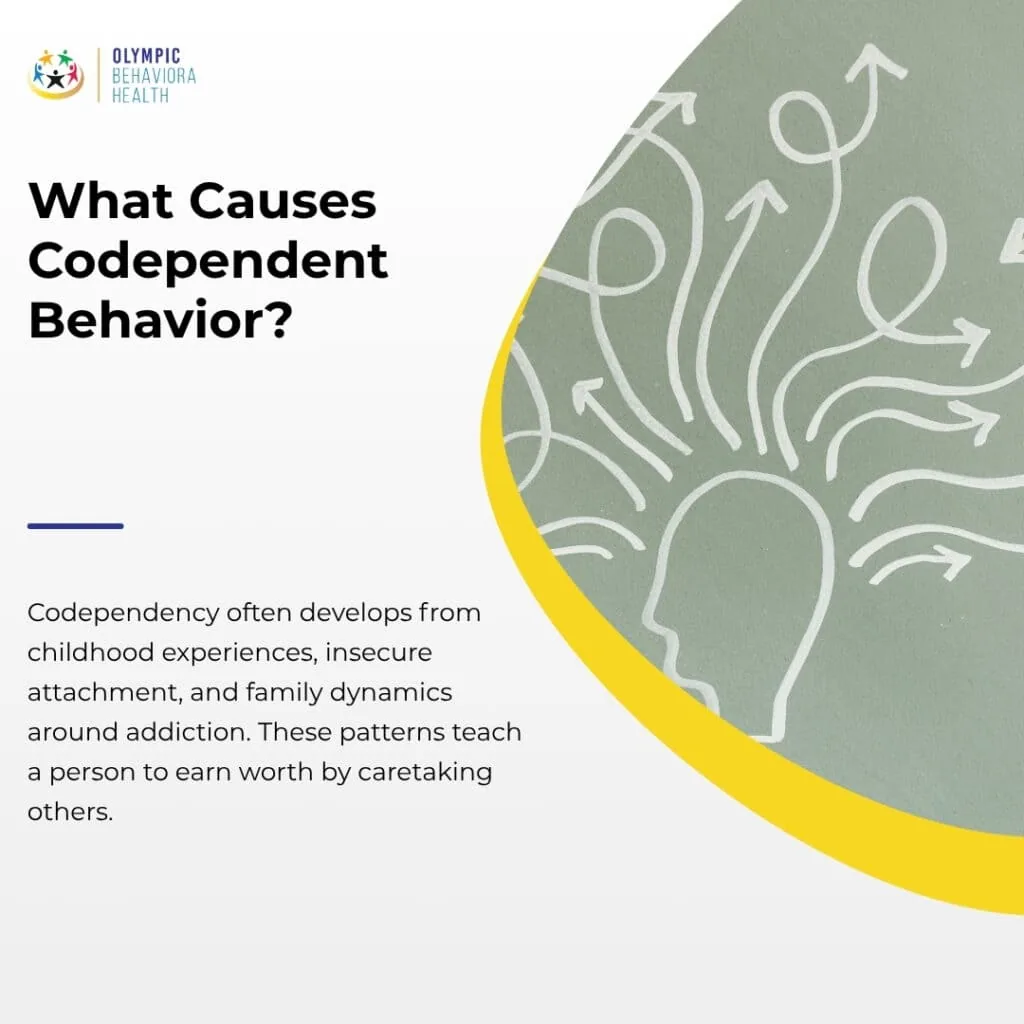
Codependent behavior develops from a combination of childhood experience, attachment patterns, and family dynamics around addiction.
Childhood and Developmental Roots
Codependency often begins in childhood environments that reward caretaking and discourage independent needs.
Developmental drivers include:
- Adverse childhood experiences: Early exposure to household dysfunction teaches a child to monitor and manage others, which lays the groundwork for codependency.
- Invalidating environments: Homes that dismiss a child’s emotions push the child toward self-sacrifice to earn approval and safety.
Rediscover Life at Olympic Behavioral Health
Get the compassionate support you deserve. We're here to help you reclaim joy, wellness, and a brighter future.
Our Facility
Attachment and Family Systems
Codependency reflects attachment patterns and family roles that carry into adult relationships.
The relational causes include:
- Anxious attachment: An anxious attachment style, described in John Bowlby’s attachment theory, drives fear of abandonment that fuels people-pleasing.
- Low differentiation of self: Murray Bowen’s family systems theory links codependency to low differentiation of self, where a person cannot separate their emotions from a family member’s.
- Enmeshment: Enmeshed families blur boundaries between members, which trains children to prioritize the family unit over personal identity.
The Family Disease Model of Addiction
Codependency is closely tied to the family disease model, which views addiction as affecting the whole household.
This connection works as follows:
- Adaptation to substance use: Family members adapt to a relative’s substance use by caretaking, and this adaptation hardens into codependency over time.
- Reinforced roles: Loving someone with a substance use disorder can reinforce a rescuer role that outlasts the active addiction.
What Are the Signs of Codependent Behavior?
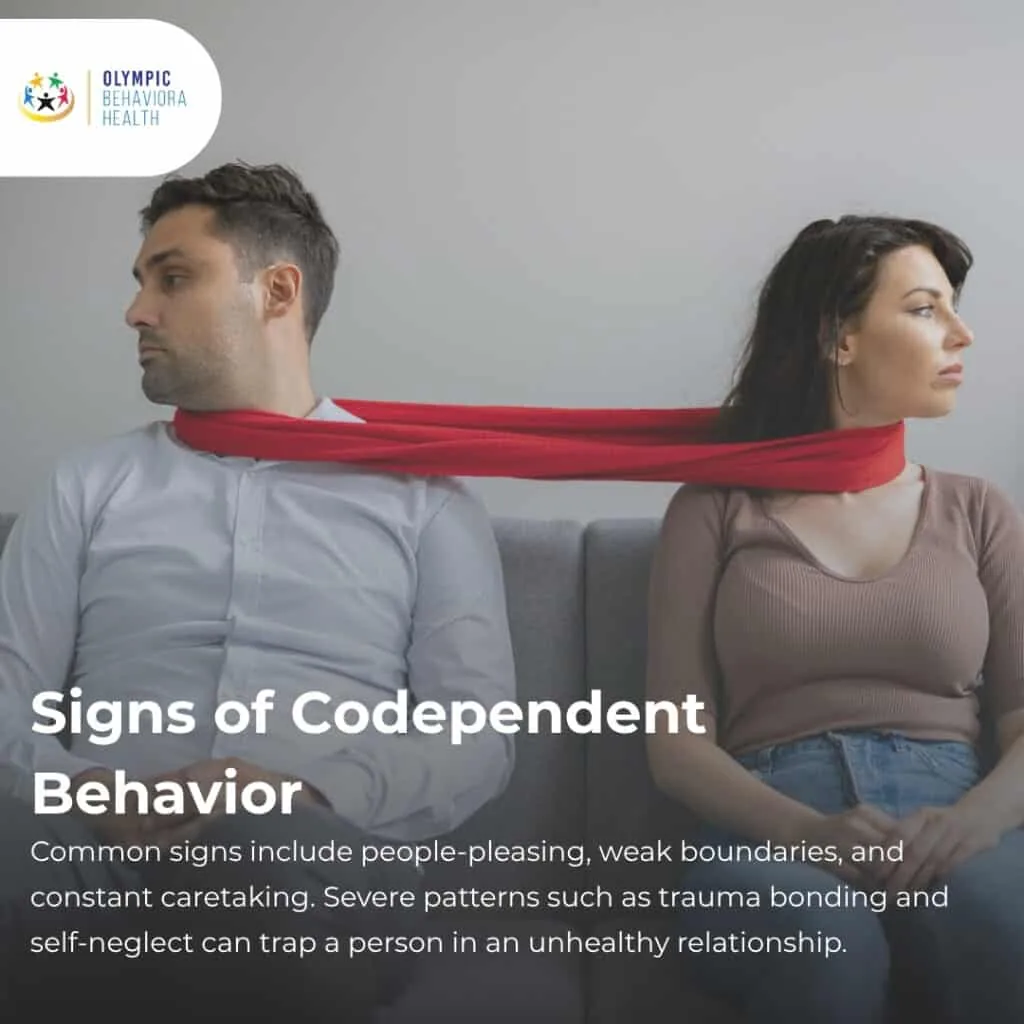
Codependent behavior shows up through recognizable signs that range from everyday habits to serious relationship harm.
Are you covered for treatment?

Olympic Behavioral Health is an approved provider for Blue Shield and Tufts while also accepting many other major insurance carriers.
Check Coverage Now!Common Signs of Codependency
Common codependency signs center on boundaries, approval, and self-worth.
Frequent everyday signs include:
- People-pleasing: A codependent person struggles to say no because their self-worth depends on approval from others.
- Poor boundaries: Codependency produces weak boundaries, so the person absorbs other people’s problems as their own.
- Caretaking to excess: The person feels responsible for fixing others, which reflects an external locus of control over their own emotions.
Severe Signs in Relationships
Severe codependency signs damage the health and balance of a relationship.
Serious warning signs include:
- Trauma bonding: Trauma bonding attaches a person to a harmful partner through cycles of conflict and reconciliation, which keeps them in an unsafe relationship.
- Control and denial: The caretaker tries to control the other person’s behavior and denies serious problems to protect the relationship.
- Self-neglect: The person abandons their own health, friendships, and goals to remain focused on someone else.
Long-Term Effects on Mental Health
Long-term codependency produces measurable effects on emotional wellbeing.
Lasting consequences include:
- Anxiety and depression: Chronic self-neglect and fear of abandonment raise the risk of anxiety and depression over time.
- Measured through assessment: Clinicians can gauge severity with the Spann-Fischer Codependency Scale (SF-CDS), a 16-item tool that measures reliance on relationships for identity.
- Resentment and burnout: Ongoing caretaking without reciprocity produces resentment and emotional exhaustion that erode the relationship further.
Did you know most health insurance plans cover substance use disorder treatment? Check your coverage online now.
Codependency vs Dependent Personality Disorder
Codependency and dependent personality disorder look similar but differ in cause, diagnostic status, and relationship role.
How Codependency Differs from Dependent Personality Disorder
Codependency centers on caretaking others, while dependent personality disorder centers on needing others to take charge.
| Feature | Codependency | Dependent Personality Disorder | Healthy Interdependence |
|---|---|---|---|
| Diagnostic status | Not a DSM-5-TR diagnosis | DSM-5-TR Cluster C personality disorder | Not a disorder |
| Core drive | Being needed and caretaking | Needing to be cared for and guided | Mutual support with autonomy |
| Sense of self | Derived from another person | Reliant on others for decisions | Stable and independent |
| Boundaries | Weak, self-sacrificing | Weak, submissive | Clear and respected |
Codependency vs Healthy Interdependence
Codependency differs from healthy interdependence, which many people mistake for the same thing.
The key contrasts are:
- Autonomy is preserved: Healthy interdependence keeps each person’s identity intact, while codependency dissolves one person’s identity into the other’s.
- Support flows both ways: Healthy relationships share support mutually, while codependency runs in one direction toward the caretaker’s sacrifice.
Contact us today to schedule an initial assessment or to learn more about our services. Whether you are seeking intensive outpatient care or simply need guidance on your mental health journey, we are here to help.
How Is Codependent Behavior Treated?
Treatment for codependent behavior combines therapy that rebuilds boundaries, self-worth, and family dynamics.
First-Line Behavioral Therapies
Evidence-based therapies help people recognize and change codependent thinking and behavior.
Leading therapies include:
- Cognitive behavioral therapy: Cognitive behavioral therapy helps clients challenge the belief that their worth depends on caretaking others.
- Dialectical behavior therapy: Dialectical behavior therapy teaches boundary-setting and emotion regulation skills that reduce self-sacrificing habits.
Family and Relationship Therapy
Family-focused therapy addresses the relationship system that sustains codependent behavior.
These approaches include:
- Bowen family systems therapy: Family systems therapy raises differentiation of self, which helps a person separate their emotions from a family member’s.
- Family and couples sessions: Joint sessions rebuild balanced roles and address co-occurring conditions that keep the pattern in place.
Rediscover Life at Olympic Behavioral Health
Get the compassionate support you deserve. We're here to help you reclaim joy, wellness, and a brighter future.
Our Facility Support Groups and Emerging Approaches
Peer support and newer therapies reinforce recovery from codependent behavior.
Additional support includes:
- Peer recovery groups: Groups such as Codependents Anonymous and Al-Anon give members a community that models healthy boundaries.
- Schema therapy: Schema therapy targets the self-sacrifice schema, an emerging focus for people whose codependency began in childhood.
Treatment at Olympic Behavioral Health
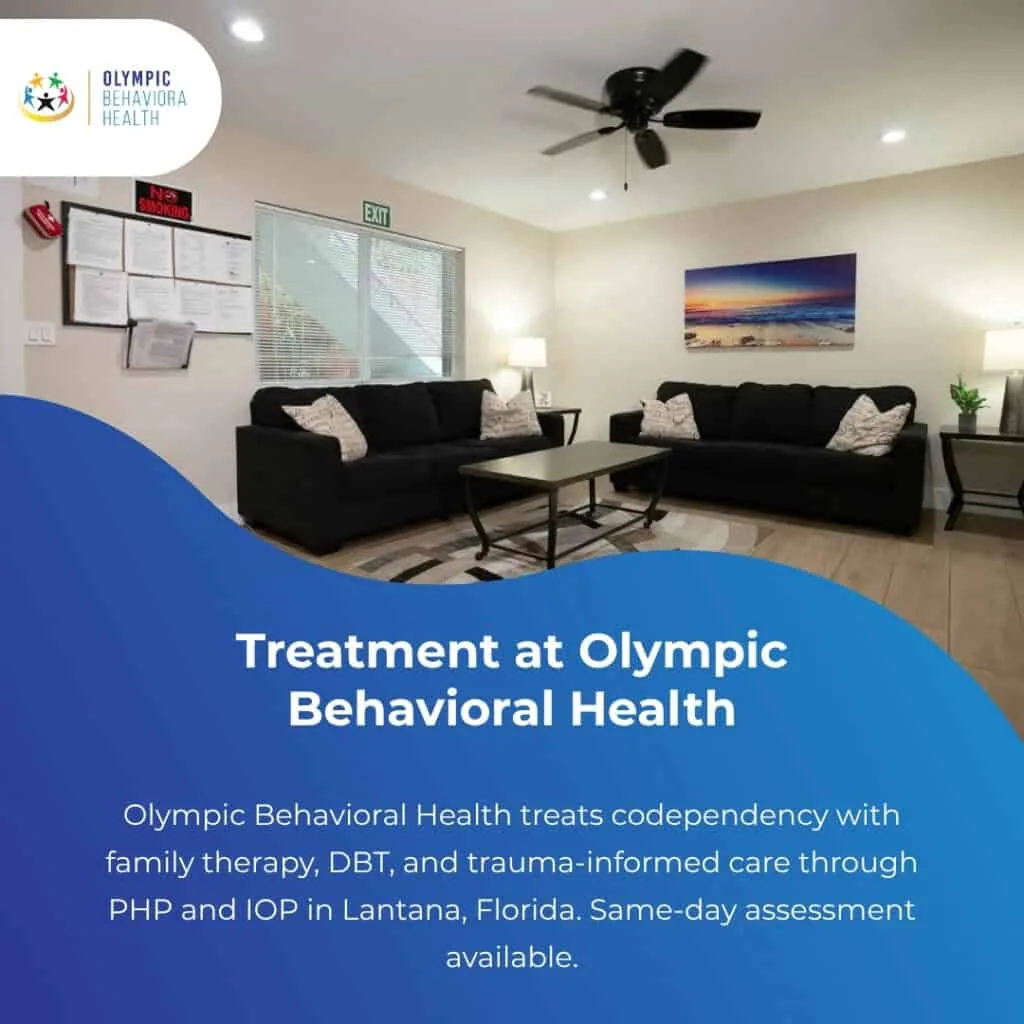
Olympic Behavioral Health treats codependent behavior alongside addiction and mental health conditions through outpatient care in Lantana, Florida, serving West Palm Beach and Palm Beach County.
Family Therapy and Support
Olympic Behavioral Health builds family involvement into every phase of treatment.
Family services include:
- Weekly family therapy: The family therapy program helps relatives set boundaries and step out of caretaking roles.
- Dedicated family meetings: Friday family meetings give loved ones a support format focused on their own struggles and coping.
According to Lisa, PhD, LMFT, Clinical Director at Olympic Behavioral Health, “Many clients come in believing that constant caretaking is love, and the turning point is when they learn that setting a boundary is not abandonment but the start of a healthier relationship.”
Are you covered for treatment?
Olympic Behavioral Health is an approved provider for Blue Shield and Tufts while also accepting many other major insurance carriers.
Check Coverage Now!Skills-Based and Trauma-Informed Care
Olympic Behavioral Health pairs skills training with trauma-informed therapy to address the roots of codependency.
This care includes:
- Boundary and coping skills: Dialectical behavior therapy groups teach the boundary and emotion-regulation skills that reduce self-neglect.
- Trauma track: A specialized trauma track uses EMDR and neurofeedback to treat the trauma that often underlies codependent patterns.
Integrated Dual Diagnosis Support
Olympic Behavioral Health treats codependency alongside any co-occurring mental health condition.
Integrated care features:
- Combined treatment plans: Clinicians address dual diagnosis needs so anxiety or depression are treated alongside relationship patterns.
- One-to-one attention: A one-to-one staff-to-client ratio supports individualized work on self-worth and boundaries.
Frequently Asked Questions
Did you know most health insurance plans cover substance use disorder treatment? Check your coverage online now.
What does codependent behavior look like?
Codependent behavior looks like constant people-pleasing, difficulty saying no, and taking responsibility for another person’s feelings. The person often neglects their own needs. Their sense of worth depends on being needed, which keeps them focused on caretaking others.
Is codependency a mental illness?
Codependency is not a formal mental illness and does not appear in the DSM-5-TR. It is a learned relationship pattern. However, its traits overlap with dependent personality disorder and insecure attachment, and it can contribute to anxiety and depression.
What causes codependency?
Codependency usually develops from childhood experiences, insecure attachment, and family dynamics around addiction. Growing up in a home with dysfunction or an unwell parent teaches caretaking early. These patterns then carry into adult relationships as excessive self-sacrifice.
Contact us today to schedule an initial assessment or to learn more about our services. Whether you are seeking intensive outpatient care or simply need guidance on your mental health journey, we are here to help.
How do you stop being codependent?
Stopping codependency starts with recognizing the pattern and building boundaries. Therapy such as cognitive behavioral therapy helps rebuild self-worth. Support groups like Codependents Anonymous provide community, and family therapy addresses the relationship system that keeps the pattern going.
Can codependency be cured?
Codependency is not an illness to cure, but it can be changed with consistent work. People learn to set boundaries, reconnect with their own needs, and form balanced relationships. Progress is gradual and strengthens with therapy and peer support.
What is the difference between codependency and dependent personality disorder?
Codependency centers on caretaking others and being needed, while dependent personality disorder centers on needing others to make decisions and take charge. Dependent personality disorder is a DSM-5-TR diagnosis, whereas codependency is a relationship pattern without formal diagnostic status.
Rediscover Life at Olympic Behavioral Health
Get the compassionate support you deserve. We're here to help you reclaim joy, wellness, and a brighter future.
Our Facility Is codependency common in families with addiction?
Yes, codependency is common in families affected by addiction. Family members often adapt to a relative’s substance use by caretaking. Research on spouses of people with substance use disorders reports codependency in more than half of those studied.
How do you set boundaries with a codependent partner?
Setting boundaries means stating your limits clearly and following through consistently. It helps to separate your emotions from your partner’s problems. Family therapy and skills-based treatment give couples tools to rebuild balanced, respectful roles over time.
Sources
- American Psychiatric Association. (2022). Diagnostic and statistical manual of mental disorders (5th ed., text rev.).
- Cermak, T. L. (1986). Diagnosing and treating co-dependence. Johnson Institute Books.
- Beattie, M. (1986). Codependent no more. Hazelden.
- Fischer, J. L., Spann, L., & Crawford, D. (1991). Measuring codependency. Alcoholism Treatment Quarterly, 8(1), 87 to 100.
- Bowen, M. (1978). Family therapy in clinical practice. Jason Aronson.
- Swedo, E. A., Aslam, M. V., Dahlberg, L. L., et al. (2023). Prevalence of adverse childhood experiences among U.S. adults, Behavioral Risk Factor Surveillance System, 2011 to 2020. MMWR. Morbidity and Mortality Weekly Report, 72(26), 707 to 715.
- Substance Abuse and Mental Health Services Administration. (2024). Key substance use and mental health indicators in the United States: Results from the 2023 National Survey on Drug Use and Health (HHS Publication No. PEP24-07-021). Center for Behavioral Health Statistics and Quality.
- Marks, A. D. G., Blore, R. L., Hine, D. W., & Dear, G. E. (2012). Development and validation of a revised measure of codependency. Australian Journal of Psychology, 64(3), 119 to 127.
Share This Post

Adam Siegel
View profile
Lisa Alleva
View profile
Treatments we offer:
Are you covered for treatment?








Olympic Behavioral Health is an approved provider for Blue Shield and Tufts, while also accepting many other major insurance carriers.
Check Coverage Now!