High-Functioning Depression: Signs and Symptoms
High-functioning depression describes meeting the symptom criteria for depression while continuing to perform at work, at home, and in social settings. The impairment is internal rather than visible.
Someone with high-functioning depression answers emails, meets deadlines, and shows up for other people. They also feel flat, exhausted, and disconnected from anything they used to enjoy.
Because performance holds, the condition rarely triggers concern from anyone, including the person experiencing it. Many people go years assuming this is simply their personality.
Knowing which symptoms define this pattern is what separates a temporary rough stretch from a treatable clinical condition.
Key Takeaways
- High-functioning depression is not a diagnosis in the DSM-5-TR. The term describes depressive symptoms that meet criteria for major depressive disorder or persistent depressive disorder without producing severe functional impairment.
- SAMHSA’s 2024 National Survey on Drug Use and Health reports that 8.2 percent of adults, or 21.4 million people, had a past-year major depressive episode. Of those, 5.6 percent of adults, or 14.7 million, had an episode involving severe impairment.
- The gap between those two SAMHSA figures describes roughly 6.7 million United States adults who met depression criteria without severe functional impairment, which is the population this term refers to.
- Judith Joseph and colleagues published the first study characterizing the clinical correlates of high-functioning depression in Cureus in 2025, based on interviews with 120 adults aged 18 to 75.
- SAMHSA found that adults aged 18 to 25 had the highest rate of past-year major depressive episode at 15.9 percent, compared with 10.0 percent among adults aged 26 to 49.
Did you know most health insurance plans cover substance use disorder treatment? Check your coverage online now.
What Is High-Functioning Depression?
High-functioning depression is a descriptive term for depressive symptoms that persist alongside maintained performance in work, caregiving, and social roles.
Why High-Functioning Depression Is Not a DSM-5-TR Diagnosis
High-functioning depression carries no diagnostic code, and understanding what it maps onto determines what treatment applies.
- The term is descriptive, not diagnostic: Joseph and colleagues noted in their 2025 Cureus study that high-functioning depression is not an official DSM-5 diagnosis. They acknowledged the concept has gained traction among clinicians and the public.
- It maps onto two formal diagnoses: Most people described as high functioning meet criteria for major depressive disorder without severe impairment, or for persistent depressive disorder. The DSM-5-TR uses persistent depressive disorder in place of the older term dysthymia.
- Functional capacity does not measure severity: Continuing to work does not indicate mild depression, and Joseph’s group hypothesized that this population is underdiagnosed precisely because impairment stays invisible.
- Under-reporting compounds the problem: Their study also proposed that people with this presentation report negative emotions less readily than people with typical depressive presentations, which lowers detection further.
The Depressive Disorders This Pattern Falls Under
The DSM-5-TR recognizes several depressive disorders, and high-functioning presentations appear across most of them.
- Major depressive disorder: Five or more symptoms present for at least two weeks, including depressed mood or anhedonia, with severity graded separately from the diagnosis itself.
- Persistent depressive disorder: Depressed mood for at least two years in adults, typically lower in intensity than a major depressive episode but far longer in duration.
- Major depressive disorder with atypical features: A specifier involving increased appetite, excessive sleep, heaviness in the limbs, and strong sensitivity to interpersonal rejection.
- Major depressive disorder with melancholic features: A specifier involving complete loss of pleasure, early morning waking, and psychomotor retardation.
- Major depressive disorder with seasonal pattern: Episodes that recur at a consistent time of year, most often during months with reduced daylight.
- Premenstrual dysphoric disorder: Mood symptoms tied to the luteal phase that resolve after menstruation begins.
Contact us today to schedule an initial assessment or to learn more about our services. Whether you are seeking intensive outpatient care or simply need guidance on your mental health journey, we are here to help.
What Causes High-Functioning Depression?
High-functioning depression develops from the same biological and environmental causes as other depressive presentations, with personality and environmental factors determining why functioning is preserved.
Neurobiological Causes
Depression involves measurable disruption in the brain systems governing mood, motivation, and stress response.
- Monoamine dysregulation reduces signal strength: Disrupted serotonin, norepinephrine, and dopamine transmission weakens the neural signaling that sustains mood and motivation.
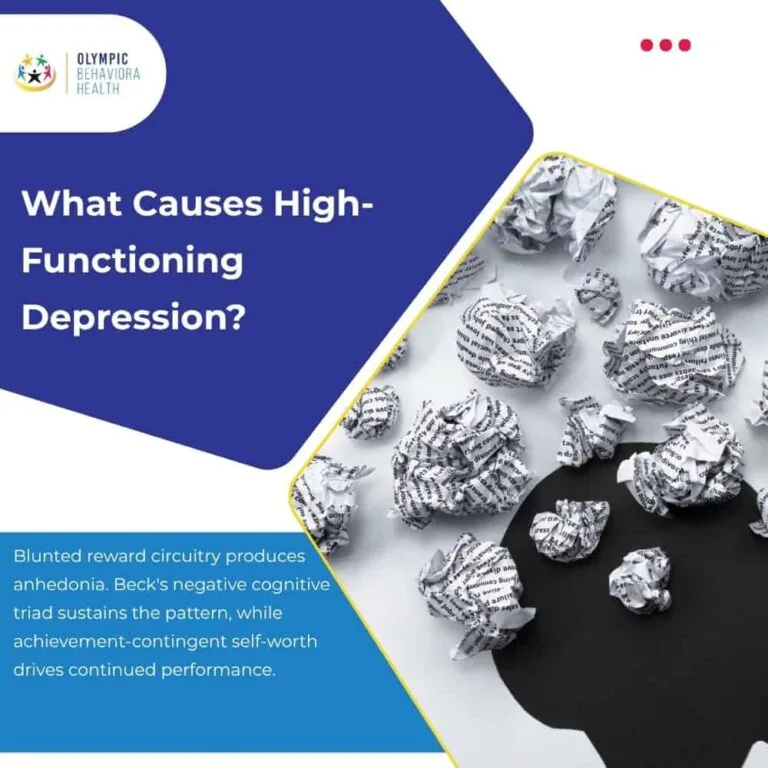
- Reward circuit blunting produces anhedonia: Reduced responsiveness in the nucleus accumbens and ventral striatum lowers the pleasure response to activities that previously delivered it, which is the mechanism behind anhedonia.
- HPA axis dysregulation elevates cortisol: Sustained hypothalamic-pituitary-adrenal axis activation raises cortisol exposure, which impairs hippocampal function and memory consolidation.
- Prefrontal hypoactivity weakens regulation: Reduced dorsolateral prefrontal cortex activity limits the cognitive control needed to interrupt negative thought cycles.
- Neuroinflammation contributes in a subset: Elevated inflammatory cytokines correlate with fatigue and anhedonia, and this pathway is a target of active investigation.
Genetic and Hereditary Factors
Depression aggregates in families, which establishes inherited vulnerability alongside environmental cause.
- Family history raises risk substantially: Having a first-degree relative with major depressive disorder elevates personal risk well above population baseline.
- No single gene determines outcome: Depression risk reflects many common genetic variants of small individual effect rather than one causal gene.
- Genetic loading interacts with environment: Inherited vulnerability raises sensitivity to environmental stress rather than producing depression independently of it.
Rediscover Life at Olympic Behavioral Health
Get the compassionate support you deserve. We're here to help you reclaim joy, wellness, and a brighter future.
Our Facility
Psychological and Environmental Causes
Environmental and personality factors explain why this presentation preserves functioning rather than collapsing it.
- Beck’s cognitive triad sustains the pattern: Aaron Beck at the University of Pennsylvania identified the negative cognitive triad of negative views of self, world, and future as the mechanism maintaining depressive thinking.
- Achievement-contingent self-worth drives performance: When self-worth depends on output, performance continues during depression because stopping feels more dangerous than exhaustion.
- Sublimation channels distress into work: Redirecting emotional pain into productivity functions as a defense mechanism, which produces visible achievement alongside internal deterioration.
- Chronic stress precedes onset: Sustained work strain, caregiving demand, and financial pressure raise depression risk without producing a single identifiable triggering event.
- Adverse childhood experiences shape response: Early experiences that rewarded compliance and performance teach suppression of distress, which becomes the adult presentation.
Co-Occurring Conditions and Their Mechanisms
Conditions that co-occur with high-functioning depression each connect through a specific pathway.
- Anxiety disorders share the arousal system: Overlapping HPA axis dysregulation explains why anxiety and depression co-occur more often than either appears alone.
- Alcohol use disorder follows the self-medication pathway: Alcohol produces short-term relief from low mood and sleep difficulty, which reinforces use and worsens depression through disrupted sleep architecture.
- Complex trauma damages self-concept directly: The persistent negative self-view in complex PTSD overlaps with depressive cognition, which is why trauma history changes the treatment sequence.
- Codependent patterns reinforce suppression: Codependent behavior prioritizes other people’s needs over one’s own, which sustains the people-pleasing that keeps depression concealed.
- Borderline pathology can underlie the presentation: Internalizing personality presentations such as quiet BPD produce depressive symptoms that do not respond to antidepressant treatment alone.
How High-Functioning Depression Progresses Over Time
High-functioning depression follows a measurable course, and the DSM-5-TR duration thresholds determine which diagnosis applies at each stage.
Are you covered for treatment?

Olympic Behavioral Health is an approved provider for Blue Shield and Tufts while also accepting many other major insurance carriers.
Check Coverage Now!The Diagnostic Timeline
Duration separates a normal low period from each formal depressive diagnosis.
- Days 1 to 13: Low mood lasting under two weeks does not meet criteria for major depressive disorder regardless of intensity.
- Day 14 onward: Five or more symptoms present for a full two weeks, including depressed mood or anhedonia, satisfies the diagnostic threshold for a major depressive episode.
- Months 6 to 24: Symptoms that persist at lower intensity across this window without full remission indicate a chronic rather than episodic course.
- Year 2 onward: Depressed mood present more days than not for at least two years in adults meets criteria for persistent depressive disorder.
- Beyond year 2: A major depressive episode occurring on top of existing persistent depressive disorder produces the pattern clinicians call double depression, which carries a poorer prognosis than either alone.
Why Recognition Arrives Years Late
The delay between symptom onset and treatment in high-functioning presentations follows a predictable sequence.
- Preserved output removes the alarm: Because deadlines are met and obligations covered, neither the person nor those around them identify a clinical problem.
- Gradual onset erases the contrast: Symptoms that emerge slowly across months provide no before-and-after comparison, so the new baseline registers as normal.
- Identity absorbs the symptoms: Persistent low mood becomes understood as being a pessimist or a private person rather than as a treatable condition.
- A crisis usually forces the issue: Job loss, relationship breakdown, or physical illness typically removes the capacity to keep performing, and that collapse is what prompts most people to seek care.
High-Functioning Depression Symptoms by Severity
High-functioning depression symptoms range from concealed daily interference to acute risk, and the tier determines the appropriate level of care.
Did you know most health insurance plans cover substance use disorder treatment? Check your coverage online now.
Common Signs of High-Functioning Depression
Common signs interfere with internal experience while leaving external performance intact.
- Anhedonia removes enjoyment: Activities that previously delivered pleasure produce nothing, and people describe this as going through the motions.
- Persistent fatigue resists sleep: Exhaustion continues regardless of hours slept, which distinguishes depressive fatigue from ordinary tiredness.
- Concentration narrows: Reading, decision-making, and sustained focus require noticeably more effort than they once did.
- Irritability replaces sadness: Low mood presents as short temper and impatience rather than visible sadness, particularly in men.
- Self-criticism runs constantly: An ongoing internal commentary of guilt and inadequacy continues regardless of external accomplishment.
- Social contact becomes performance: Maintaining relationships requires deliberate effort, and time with other people produces depletion rather than restoration.
- Sleep and appetite shift: Early morning waking, difficulty falling asleep, or changes in appetite in either direction accompany the mood symptoms.
Severe Symptoms and Warning Signs
Severe symptoms indicate the presentation has escalated beyond what preserved functioning can conceal.
- Functional cracks appear: Missed deadlines, declining work quality, or withdrawal from obligations signal that compensatory capacity has been exhausted.
- Hopelessness becomes fixed: A stable belief that circumstances cannot improve is a stronger predictor of risk than reported sadness.
- Suicidal thinking emerges: Thoughts of death or not wanting to continue require immediate clinical assessment, and preserved functioning does not reduce that risk.
- Substance use escalates: Increasing alcohol or sedative use to manage mood or sleep compounds depression and requires coordinated dual diagnosis assessment.
- Physical symptoms intensify: Unexplained pain, digestive problems, and psychomotor retardation reflect the physiological burden of sustained depression.
Seek emergency care immediately if any of the following are present:
- Thoughts of ending your life, with or without a plan.
- A belief that other people would be better off without you.
- Inability to maintain your own basic safety and daily care.
- Escalating alcohol or substance use alongside hopelessness.
The 988 Suicide and Crisis Lifeline is available 24 hours a day by calling or texting 988.
Long-Term Effects of Untreated High-Functioning Depression
Untreated high-functioning depression accumulates damage across health, relationships, and career trajectory.
- Episodes recur more readily: Each untreated depressive episode lowers the threshold for the next, which converts an episodic condition into a chronic one.
- Chronicity becomes established: Joseph and colleagues noted that untreated high-functioning depression can intensify and progress into major depressive disorder.
- Physical health declines: Sustained cortisol elevation contributes to cardiovascular risk, immune suppression, and metabolic dysfunction.
- Relationships erode quietly: Emotional unavailability and withdrawal accumulate over years, and partners frequently describe the person as present but absent.
- Career plateaus despite performance: Sustained compensatory effort produces burnout that limits advancement even while output metrics stay acceptable.
Contact us today to schedule an initial assessment or to learn more about our services. Whether you are seeking intensive outpatient care or simply need guidance on your mental health journey, we are here to help.
High-Functioning Depression vs Major Depression vs Dysthymia
High-functioning depression, major depressive disorder, and persistent depressive disorder differ across duration, severity, and functional impact rather than describing separate illnesses.
Comparing the Three Presentations
The table below separates the descriptive term from the two formal diagnoses it maps onto.
| Feature | High-Functioning Depression | Major Depressive Disorder | Persistent Depressive Disorder |
|---|---|---|---|
| Diagnostic status | Descriptive term, no DSM-5-TR code | DSM-5-TR diagnosis | DSM-5-TR diagnosis, formerly dysthymia |
| Minimum duration | Not defined | 2 weeks | 2 years in adults |
| Symptom intensity | Mild to moderate | Moderate to severe | Lower intensity, longer duration |
| Functional impairment | Preserved externally | Often visible | Chronic and understated |
| Typical presentation | Anhedonia and fatigue with intact output | Clear change from baseline | Treated as personality by the person |
| Detection rate | Frequently missed | More often identified | Frequently missed |
| First-line treatment | Psychotherapy, medication when indicated | Psychotherapy plus medication | Combined treatment, longer course |
Where the Distinction Changes Treatment
Which formal diagnosis applies determines expected treatment duration and monitoring intensity.
- Duration drives the treatment length: Persistent depressive disorder requires longer treatment courses than a single major depressive episode, because the pattern has been reinforced across years.
- Chronic presentations respond better to combined treatment: Long-standing depressive patterns show stronger response to psychotherapy plus medication than to either approach alone.
- Preserved functioning delays escalation: Because output holds, clinicians may keep a person at a lower level of care longer than symptom severity warrants.
- Double depression needs closer monitoring: A major depressive episode layered on persistent depressive disorder carries a poorer prognosis and warrants more frequent review.
Rediscover Life at Olympic Behavioral Health
Get the compassionate support you deserve. We're here to help you reclaim joy, wellness, and a brighter future.
Our Facility How High-Functioning Depression Is Diagnosed
Diagnosis combines a validated symptom measure with clinical interview covering duration, history, and functional impact.
The Patient Health Questionnaire-9
The Patient Health Questionnaire-9 (PHQ-9) is the standard instrument used to screen for and grade depression severity.
- Format and scoring: The PHQ-9 scores each of the nine DSM depression criteria from 0 to 3 across the prior two weeks, producing a total between 0 and 27.
- Validation performance: Kroenke, Spitzer and Williams validated the measure in roughly 6,000 primary care and obstetrics patients. Writing in the Journal of General Internal Medicine in 2001, they reported that a score of 10 or above made a clinician diagnosis of depression substantially more likely.
- Severity bands guide care level: Scores of 5 to 9 indicate mild symptoms, 10 to 14 moderate, 15 to 19 moderately severe, and 20 or above severe.
- The final item screens risk separately: Item nine asks about thoughts of death or self-harm, and any endorsement triggers direct safety assessment regardless of total score.
Why the PHQ-9 Can Underestimate This Presentation
Standard screening measures systematically underdetect high-functioning depression for identifiable reasons.
- Self-report depends on acknowledgment: Joseph and colleagues proposed that this population reports negative emotions less readily, which lowers scores independently of actual symptom burden.
- Functional items score low: Questions about difficulty completing work and daily tasks receive low ratings because those tasks are still being completed.
- Dedicated instruments are emerging: Joseph’s group used purpose-built high-functioning depression measures in their 2025 study, and these tools remain research instruments rather than validated clinical standards.
- Clinical interview remains necessary: Duration, anhedonia severity, and the effort required to maintain functioning surface in interview rather than on a questionnaire, which is why individual assessment matters more than a score.
Are you covered for treatment?
Olympic Behavioral Health is an approved provider for Blue Shield and Tufts while also accepting many other major insurance carriers.
Check Coverage Now!Treatment for High-Functioning Depression
High-functioning depression responds to the same evidence-based treatments as other depressive presentations, with the main obstacle being that people delay seeking them.
First-Line Psychotherapies
Four named psychotherapies hold the strongest evidence base for depressive disorders.
- Cognitive behavioral therapy restructures the triad: Cognitive behavioral therapy identifies and modifies the negative automatic thoughts Beck described, and it holds the largest evidence base for depression.
- Behavioral activation restores reward contact: Behavioral activation schedules valued activity independently of motivation, which directly targets anhedonia rather than waiting for mood to improve first.
- Interpersonal psychotherapy addresses relational triggers: Interpersonal psychotherapy targets role transitions, grief, and interpersonal disputes that maintain depressive episodes.
- Mindfulness-based cognitive therapy prevents recurrence: Mindfulness-based cognitive therapy reduces relapse risk in people with multiple prior episodes by interrupting rumination before it escalates.
First-Line Medications
Antidepressant prescribing follows a class-based sequence with switching or augmentation when response is inadequate.
- SSRIs are the standard first choice: Sertraline, escitalopram, and fluoxetine are prescribed first because of tolerability and evidence strength.
- SNRIs serve as a second class: Venlafaxine and duloxetine are used when SSRIs produce inadequate response, and duloxetine also addresses co-occurring pain.
- Atypical agents target specific symptoms: Bupropion addresses fatigue and low motivation without sexual side effects, and mirtazapine addresses insomnia and appetite loss.
- Response takes weeks, not days: Antidepressant effect typically requires four to six weeks at an adequate dose, and stopping early is a common reason treatment appears to fail.
Did you know most health insurance plans cover substance use disorder treatment? Check your coverage online now.
Second-Line and Adjunct Treatments
Adjunct approaches extend response when first-line psychotherapy and medication leave symptoms in place.
- Augmentation strategies add a second agent: Adding lithium, an atypical antipsychotic such as aripiprazole, or thyroid hormone is used when antidepressant monotherapy produces partial response.
- Group therapy interrupts isolation: Group therapy supplies corrective social contact and reduces the shame that maintains concealment.
- Exercise produces measurable symptom reduction: Structured aerobic exercise reduces depressive symptoms and functions as an adjunct rather than a replacement for treatment.
- Sleep and nutrition intervention stabilizes baseline: Correcting sleep architecture and nutritional deficiency raises the threshold at which mood symptoms escalate.
Emerging and Investigational Treatments
Several depression treatments occupy different points in the approval pipeline.
- Esketamine holds FDA approval: Intranasal esketamine is FDA-approved for treatment-resistant depression and for depression with acute suicidal ideation, and it is administered under monitoring.
- Transcranial magnetic stimulation is approved and non-invasive: Repetitive transcranial magnetic stimulation is FDA-cleared for treatment-resistant depression and requires no anesthesia or sedation.
- Psilocybin-assisted therapy remains in trials: Psilocybin-assisted therapy for depression is in late-phase clinical trials and holds no approved indication.
- Neurofeedback is under study: Neurofeedback is being investigated as an adjunct for mood and arousal regulation, with the strongest current trial evidence in trauma populations.
High-Functioning Depression Treatment at Olympic Behavioral Health
Olympic Behavioral Health treats major depressive disorder through a true outpatient continuum in Lantana, Florida, structured so clients can receive intensive care without leaving work entirely.
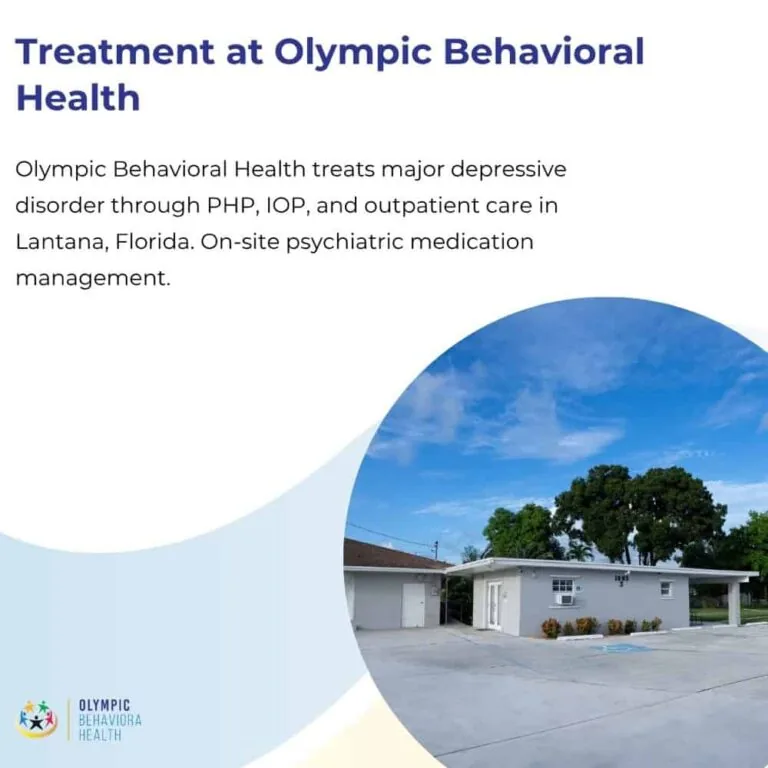
Contact us today to schedule an initial assessment or to learn more about our services. Whether you are seeking intensive outpatient care or simply need guidance on your mental health journey, we are here to help.
Partial Hospitalization Program
The partial hospitalization program provides daily clinical structure for depressive symptoms that have overwhelmed a person’s compensatory capacity.
- Schedule and duration: Programming runs 9 AM to 12 PM and 12:30 PM to 3:30 PM seven days a week. Weekend groups run 10 AM to 1 PM, and average length of stay is 30 to 45 days.
- Groups separate by primary presentation: Mental health, substance use, and dual diagnosis tracks run separately, so depression-focused content is not diluted by addiction programming.
- Mental health groups target depressive mechanisms: Standing groups cover biopsychosocial diagnosis psychoeducation, mindfulness training, DBT skills training, art therapy, and dysfunctional family systems.
- Psychiatric care is on site: A board-certified psychiatrist and a board-certified psychiatric ARNP manage medication, which allows antidepressant initiation and adjustment inside the program.
- The outpatient model preserves autonomy: Clients keep phone access and personal freedoms rather than residential-style restrictions, which matters for people whose self-concept rests on continued functioning.
Intensive Outpatient Program
The intensive outpatient program continues depression treatment on a schedule compatible with employment.
- Schedule: Groups run 9 AM to 12 PM Monday through Saturday, with an average length of stay of 30 to 45 days.
- Group content matches PHP: Programming during group hours mirrors the partial hospitalization curriculum, preserving continuity through the step-down.
- Individual therapy continues weekly: Every client receives a weekly 50 to 60 minute session with an assigned primary therapist at every level of care.
- Vocational support runs in parallel: Job search support through The Hub addresses the career impact that accumulates during untreated depression.
Outpatient Program
The outpatient program maintains clinical contact through the period when relapse risk is highest.
- Schedule: Programming consists of one weekly three-hour group session, totaling four hours per week.
- Designed for step-down and local clients: The program serves clients moving down from higher levels of care and Palm Beach County residents living off property.
- Continued contact supports relapse prevention: Ongoing group participation maintains the monitoring that matters most in the months after symptoms improve.
Rediscover Life at Olympic Behavioral Health
Get the compassionate support you deserve. We're here to help you reclaim joy, wellness, and a brighter future.
Our Facility The Clinical Team Treating Depression
Olympic Behavioral Health maintains a dually licensed clinical team for substance use and mental health with a one-to-one overall staff-to-client ratio.
- Mental health therapy: Stephanie Gass, MS treats both substance use and mental health presentations, and Gina Savino, LMFT treats primary mental health cases.
- Medication management: Medical Director Dr. Maryam Davari is a board-certified psychiatrist, and Sabina D. Thomas practices as a board-certified psychiatric Advanced Registered Nurse Practitioner.
- Clinical leadership: Clinical Director Lisa Alleva holds a PhD and licensure as a Licensed Marriage and Family Therapist, and she completes clinical approval for every admission.
- Accreditation: The facility holds Joint Commission accreditation, FARR accreditation, Florida Department of Children and Families licensure, LegitScript certification, and NAATP membership.
“Preserved functioning does not mean mild illness, and it does not mean a lower medication threshold. I assess duration and anhedonia severity rather than how well someone is holding their life together, because holding it together is often the symptom doing the most damage.”
Dr. Maryam Davari, Medical Director, Olympic Behavioral Health
Frequently Asked Questions
What are the symptoms of high-functioning depression?
Core symptoms include anhedonia, persistent fatigue, poor concentration, guilt, irritability, and changes in sleep or appetite, all while work and obligations continue. Joseph and colleagues characterized this presentation in 2025 as depressive symptoms without a corresponding loss of functioning. The symptoms match major depressive disorder criteria. Only the visible impairment differs.
Are you covered for treatment?
Olympic Behavioral Health is an approved provider for Blue Shield and Tufts while also accepting many other major insurance carriers.
Check Coverage Now!What is it like to live with high-functioning depression?
Most people describe it as running on empty while looking fine. Daily tasks get completed through deliberate effort rather than motivation, and enjoyment is absent from activities that once provided it. Social contact feels like performance. The gap between how you appear and how you feel becomes its own source of isolation.
How is functional depression treated?
Treatment follows the same evidence base as other depressive presentations: cognitive behavioral therapy, behavioral activation, and antidepressant medication when indicated. Behavioral activation is particularly relevant because it schedules valued activity without waiting for motivation to return. Structured outpatient programs help when symptoms have persisted despite weekly therapy.
Is high-functioning depression the same as dysthymia?
They overlap but are not identical. Dysthymia, now called persistent depressive disorder in the DSM-5-TR, requires depressed mood for at least two years in adults. High-functioning depression describes preserved functioning regardless of duration. A person can have either one without the other, or both together.
Did you know most health insurance plans cover substance use disorder treatment? Check your coverage online now.
Can you have high-functioning depression and not know it?
Yes, and this is common. When onset is gradual, there is no before-and-after contrast to notice, so the depressive baseline gets absorbed into identity. Many people describe realizing only in retrospect that years of feeling flat were symptoms rather than personality.
Does high-functioning depression get worse without treatment?
Joseph and colleagues noted that untreated high-functioning depression can persist, intensify, and progress into major depressive disorder. Each untreated episode also lowers the threshold for subsequent episodes. Preserved functioning does not indicate a self-limiting condition.
Do men and women present differently?
Depression in men more often surfaces as irritability, anger, risk-taking, and increased alcohol use rather than reported sadness, which contributes to underdiagnosis. Women are diagnosed with depression at roughly twice the rate of men. Part of that gap likely reflects differences in presentation and help-seeking rather than true prevalence alone.
Contact us today to schedule an initial assessment or to learn more about our services. Whether you are seeking intensive outpatient care or simply need guidance on your mental health journey, we are here to help.
Can therapy work if I am still functioning well?
Yes. Treatment eligibility depends on meeting symptom criteria, not on failing at work or relationships. Preserved functioning can make therapy more productive, because cognitive capacity and daily structure are still intact. Waiting for a collapse before seeking care makes treatment longer rather than shorter.
Sources
-
- Joseph, J. F., Tural, U., Joseph, N. D., Mendoza, T. E., Patel, E., Reifer, R., & Deregnaucourt, M. (2025). Understanding high-functioning depression in adults. Cureus, 17(2), e78891.
-
- Substance Abuse and Mental Health Services Administration. (2025). Key substance use and mental health indicators in the United States: Results from the 2024 National Survey on Drug Use and Health (HHS Publication No. PEP25-07-007, NSDUH Series H-60). Center for Behavioral Health Statistics and Quality.
-
- Kroenke, K., Spitzer, R. L., & Williams, J. B. W. (2001). The PHQ-9: Validity of a brief depression severity measure. Journal of General Internal Medicine, 16(9), 606-613.
-
- American Psychiatric Association. (2022). Diagnostic and statistical manual of mental disorders (5th ed., text rev.). American Psychiatric Publishing.
-
- Beck, A. T., Rush, A. J., Shaw, B. F., & Emery, G. (1979). Cognitive therapy of depression. Guilford Press.
-
- High-functioning depression: A hidden burden demanding clinical recognition. (2025). BJPsych Bulletin, 50(2), 111-113.
-
- National Institute of Mental Health. (n.d.). Major depression. U.S. Department of Health and Human Services, National Institutes of Health.
-
- Kessler, R. C., & Bromet, E. J. (2013). The epidemiology of depression across cultures. Annual Review of Public Health, 34, 119-138.
Share This Post

Adam Siegel
View profile
Lisa Alleva
View profile
Treatments we offer:
Are you covered for treatment?








Olympic Behavioral Health is an approved provider for Blue Shield and Tufts, while also accepting many other major insurance carriers.
Check Coverage Now!